

What is AI automation — and what it actually is not
Ask ten people in a boardroom what "AI automation" means and you will get ten different answers. Some will describe the chatbot on their website. Others will reference a tool that generates marketing copy. A few will talk about robotic process automation they implemented five years ago. Almost none of them will be wrong — and almost none of them will be fully right.
This ambiguity is not accidental. The phrase has been stretched across every category of software that touches productivity, data, or workflows. That makes it useful for selling but nearly useless for decision-making. Before a business invests in building or deploying intelligent systems, it needs to understand what it is actually building — and what it is not.
Start with what it actually is
AI automation is the use of machine learning models — particularly large language models — to perform tasks that previously required human judgment, not just rule-following. The distinction matters enormously.
Traditional automation is deterministic. You define inputs, conditions, and outputs. The system executes. It is reliable, fast, and brittle: it does exactly what it is told and nothing more. Ask it to handle something it was not explicitly programmed for and it fails.
AI automation introduces the capacity for interpretation. A well-designed AI system can read an ambiguous customer message and infer intent. It can process an unstructured document and extract relevant fields. It can evaluate a lead's characteristics against a set of soft criteria and produce a qualification score. It reasons, to a degree, rather than merely executing.

In practice, AI automation tends to operate across three layers: understanding inputs (reading emails, transcripts, documents, queries), making decisions or generating outputs (drafting replies, summarizing content, routing tasks, flagging anomalies), and triggering downstream actions (updating a CRM, sending a notification, escalating to a human).
When these layers are chained together — often across multiple agents — you get what is increasingly called agentic automation: systems that pursue goals through multi-step reasoning rather than single, isolated tasks.
What it is commonly mistaken for
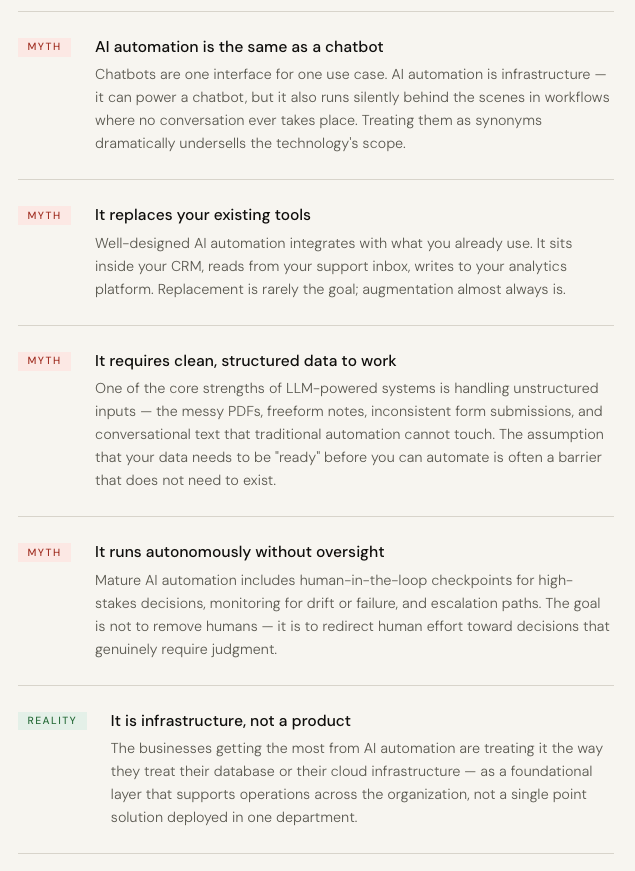
Clarity on what AI automation is not protects against both overselling and underinvesting. These are the most common conflations.
COMMON MYTHS VS. REALITY
Where it creates real value
Understanding the technology is useful; understanding where it reliably creates business value is what drives decisions. Based on what we see in production deployments, the highest-impact applications tend to cluster around a few categories.
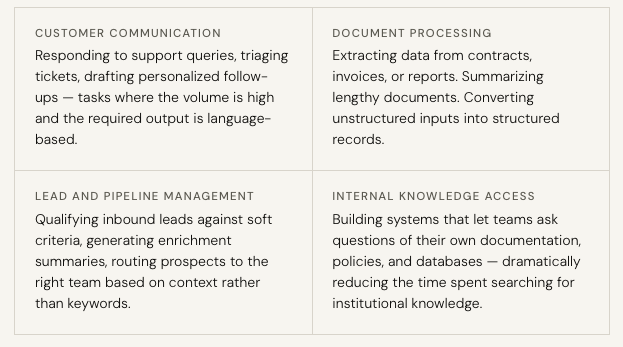
The common thread is high-volume, language-intensive work that does not require human creativity or relational judgment but does require more than mechanical rule-following. That is the zone where AI automation operates best.
A word on what it genuinely cannot do
AI automation cannot replace strategic thinking. It cannot build client relationships. It cannot exercise ethical judgment in novel situations. It should not make consequential decisions without a human review step when stakes are high. It will make mistakes — particularly on edge cases and unusual inputs — and well-designed systems account for this with monitoring, escalation paths, and feedback loops.
These are not arguments against adoption. They are arguments for building thoughtfully. The businesses that get the most from AI automation are not the ones that deploy it everywhere — they are the ones that identify the right workflows, design appropriate guardrails, and treat it as a system to be maintained rather than a switch to be flipped.
The right question to ask
The most useful question is not "can AI automate this?" — the answer is almost always technically yes. The right question is: where does freeing up human attention create the most downstream value for this business?
Start there. Map the workflows that consume the most time with the least differentiated thinking. Design for those first. Build incrementally. Measure what changes.
That is how AI automation stops being a buzzword and starts being infrastructure.