

The next wave of digital transformation

The first era of digital transformation was about getting data out of silos and onto screens. Businesses invested heavily in analytics platforms, business intelligence tools, and reporting dashboards. The promise was compelling: if everyone could see what was happening in real time, better decisions would follow.
For many organisations, that promise was partially fulfilled. Dashboards became a fixture of the modern workplace. KPIs were visualised. Reports were automated. Data teams grew. And yet, in most companies, a gap remained — a persistent, expensive gap between seeing and doing.
Someone still had to read the dashboard. Interpret the anomaly. Decide what action to take. Route the task to the right person. Follow up to make sure it happened. The data was visible. The work was still manual.
That gap is now closable. And closing it represents the next wave of digital transformation.
How we got here
To understand where we are going, it helps to map the arc of how businesses have used technology to improve operations over the last two decades.
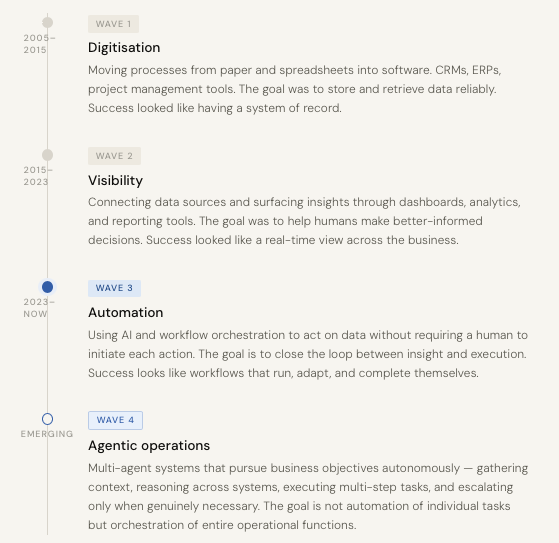
Most businesses today are somewhere between Wave 2 and Wave 3. The companies pulling ahead are already building Wave 4 infrastructure — not waiting for it to become standard before they start.
The dashboard problem, precisely stated
Dashboards were a genuine leap forward. But their fundamental model is passive: they display information and wait for a human to respond. In a world where response time is a competitive variable — where the difference between a qualified lead contacted in five minutes and one contacted in five hours is measured in conversion rates — passive visibility is no longer enough.

This is not a marginal difference. It is a structural one. The organisation running on dashboards requires a human to be watching, awake, available, and motivated to act at precisely the right moment. The organisation running on agents does not.
The same logic applies across every function. A dashboard shows that customer churn risk is elevated for a segment. An agent reaches out to those customers. A dashboard flags that a supplier delivery is delayed. An agent notifies the relevant team, updates the affected orders, and drafts a customer communication. A dashboard reports that a content campaign is underperforming. An agent pauses the spend and routes a summary to the marketing lead.
In each case, the dashboard provided visibility. The agent provided resolution.
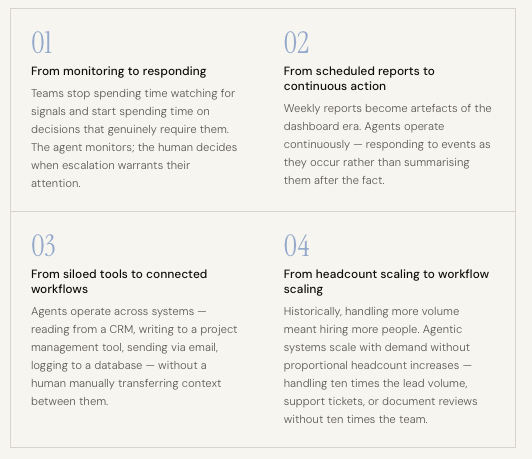
What actually changes
Who is already making this shift
This is not a future scenario. The transition from dashboards to agents is underway in specific industries where response speed, volume, and operational complexity make the value immediately obvious.
In fintech, agents are monitoring transaction anomalies, triggering compliance checks, and notifying teams — all without human initiation. In e-commerce, agents are managing inventory alerts, handling routine customer queries, and qualifying wholesale enquiries at scale. In SaaS, agents are handling onboarding sequences, monitoring churn signals, and routing high-value accounts to the right team member automatically.
The pattern is consistent: companies in these sectors are not waiting for the technology to mature further before committing. They are building now and compounding the advantage.
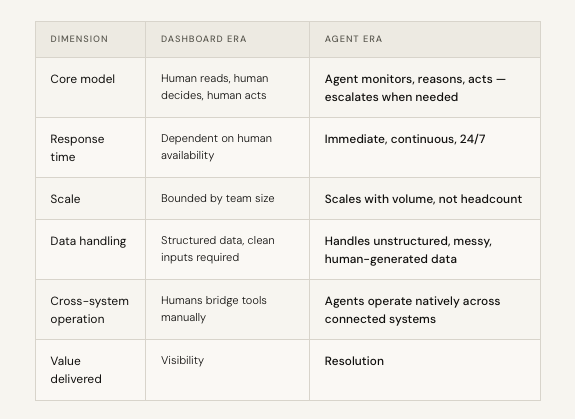
The comparison that clarifies the decision
For businesses still weighing whether and when to make this transition, the following comparison tends to crystallise the stakes.
What this does not mean
It is worth being precise about the limits of this shift, because they matter for how organisations plan.
Agentic systems are not autonomous businesses. They operate best on well-defined workflows where the range of inputs and acceptable outputs can be reasoned about in advance. They require human oversight for high-stakes decisions. They need to be monitored for drift and failure. They will occasionally get things wrong, and well-designed systems surface those failures quickly rather than amplifying them silently.
The transition from dashboards to agents is not about removing humans from operations. It is about changing where human attention is directed — away from routine execution and toward genuine judgment, relationship-building, and strategic decision-making that no agent should be making alone.
How to start
The most common mistake organisations make is trying to automate everything at once. The more reliable path is to identify a single high-volume, time-sensitive workflow where the cost of slow human response is measurable — and build there first.
Qualify that one workflow end-to-end. Measure the before and after. Use that result to build internal confidence and investment for the next layer. The organisations that build agentic infrastructure well do so incrementally, with clear success metrics at each stage, not in a single sweeping transformation programme.
The dashboard era gave businesses the ability to see. The agent era gives them the ability to act — at scale, continuously, and without waiting for someone to notice the signal first.
The question is no longer whether this shift is coming. It is whether your organisation will be ahead of it or catching up to it.